Three 1:1 essay coaching sessions
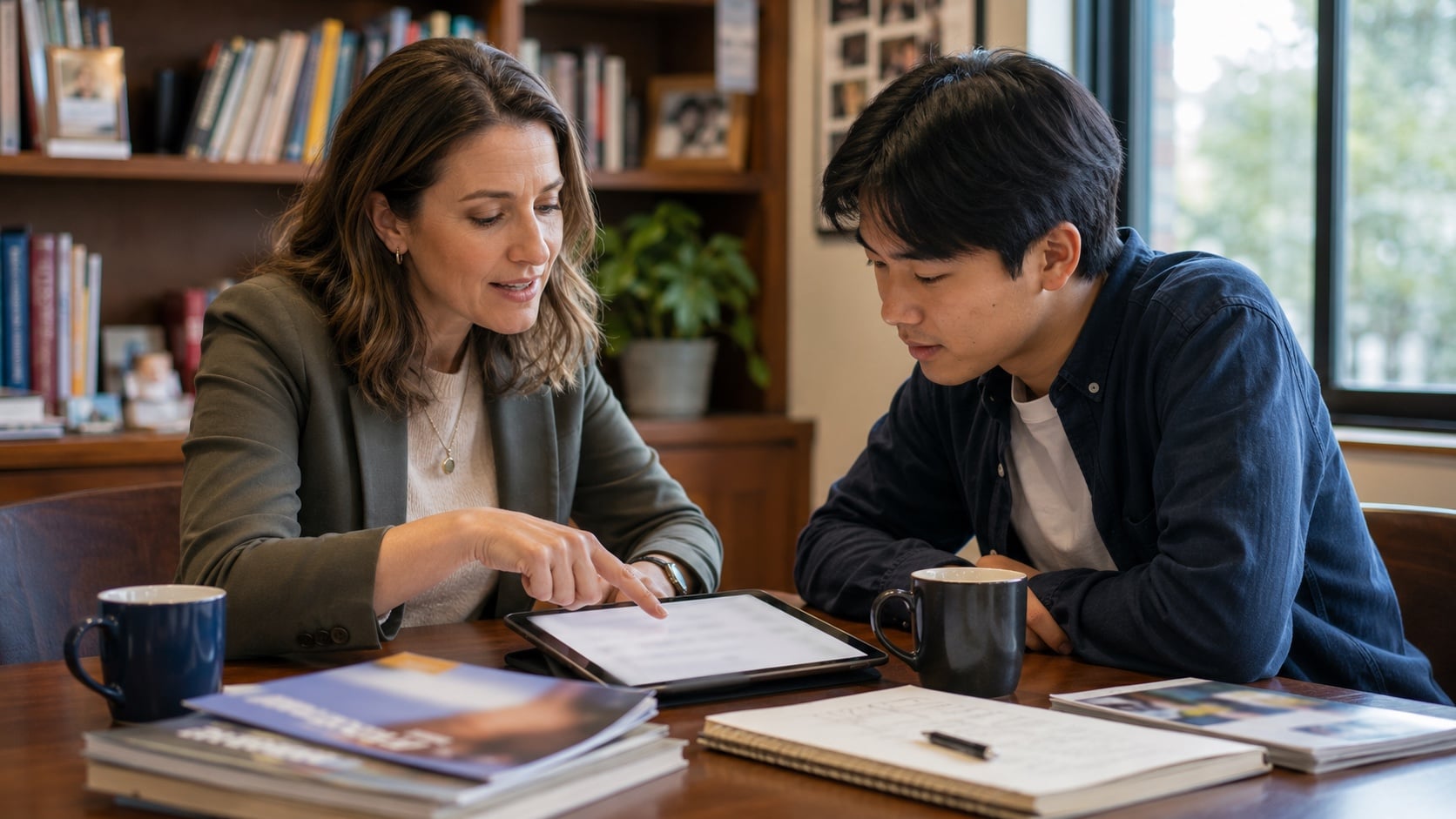
We sit with your child across three sessions to draft, revise, and polish a Common App essay built around their capstone. Each session ends with concrete feedback your child can act on between sessions.
The admissions wedge · Week 3 of the Summer Institute
Three essay coaching sessions, a mock college interview, and a narrative architecture session that ties the capstone to the rest of your child's profile. Most AI summer programs do not do admissions. We do.
Four Week-3 deliverables
We sit with your child across three sessions to draft, revise, and polish a Common App essay built around their capstone. Each session ends with concrete feedback your child can act on between sessions.
A 30-minute mock interview with feedback on framing, body language, and the way your child talks about their capstone. We focus on the questions admissions interviewers actually ask.
We sit with your child to map the connection between the capstone and the rest of their profile — coursework, extracurriculars, prior projects. The output is a one-page narrative architecture your child can reference across every application.
Your child leaves Week 3 with a draft an admissions reader could actually verify — specific, technical, and verifiably their own voice.
Why this is the wedge
An admissions reader at a top university is looking for the rare applicant who can articulate, in their own words, what the practice of medicine, law, finance, engineering, or entrepreneurship actually requires of an AI system. A working AI agent shipped to a personal URL — with an architecture writeup an admissions reader can verify — is unusually concrete evidence of that interest.
But the project is only half the story. The Common App essay is where most strong applicants get stuck — the technical detail does not make it to the page, the narrative does not connect to the rest of the profile, and the voice ends up sounding like every other applicant. Week 3 fixes that, in three coaching sessions.
Selective by design
Selective admissions for the inaugural Summer 2028 cohort. We expect a 40 to 60 percent admit rate. Rolling applications through Spring 2028.
“We do not yet have AI College Prep alumni data — by intent, not omission.”
— Jinwoong “Peter” Lee, founder. No guarantees, no implied admit promises — outcomes get published here when they are real.